Identity security: The essential foundation for every CISO’s 2026 cybersecurity strategy

When I first joined CyberArk, it wasn’t just about the company or the technology, but a belief.
A belief that identity security is the foundation of cybersecurity.
Identity security is the unifying thread that ties together risk management, resilience, and trust in an era where identity—human, AI, and machine—has become the true perimeter of the enterprise.
Every day, I see how this conviction plays out across industries and organizations. Whether teams are protecting privileged access, securing cloud workloads, or enabling zero trust at scale, it all starts with identity. Yet many CISOs still treat identity and access management (IAM) as an operational function, rather than a strategic pillar. That needs to change.
According to Gartner®, “Credential compromise is the leading cause of breaches, yet the importance of IAM in achieving cybersecurity objectives, such as the implementation of zero-trust controls, is often overlooked.1” And despite that, only one in five organizations effectively achieves both identity and access management (IAM) goals of minimizing loss and increasing business agility. These findings highlight a persistent truth: IAM is more than just another line item in the security budget. It has become the backbone of the modern cybersecurity strategy.
Why identity is the new control plane for zero trust security
Today, hybrid work, AI-driven automation, and rapidly expanding, increasingly interconnected digital ecosystems define the world. To keep those complex ecosystems safe, identity must be the new control plane.
After all, every access point, transaction, and digital interaction is tied to an identity.
As Gartner emphasizes, the days of relying on static, perimeter-based defenses are gone. Instead, CISOs must adopt “identity-first security,” in which identity-based controls become the foundation of an organization’s cybersecurity architecture.
By adopting identity-first security, teams embrace a mindset shift toward more consistent, context-aware, and continuous protection across users, devices, workloads, and applications. Identity-first security enables teams to dynamically assess trust and risk in real time, aligning with the tenets of a zero trust philosophy.
When identity becomes the control plane, organizations can move from reactive defense to proactive resilience, detecting anomalies, containing threats, and continuously verifying trust before granting access.
Unlocking the strategic value of identity security and IAM for CISOs
CISOs today face an overwhelming mandate to reduce risk, support business agility, and ensure compliance while enabling innovation. Too often, IAM is viewed as a technical project instead of a strategic enabler of these goals.
Gartner recommends to “Align the IAM program with the cybersecurity strategy by benchmarking IAM maturity and gaps, leveraging them for planning and prioritization.1” It strengthens resilience by addressing credential misuse, the leading cause of breaches, and enhances agility by streamlining access across complex environments.
The most effective IAM programs share three core characteristics:
- Integration with the cybersecurity strategy: Aligning IAM priorities with enterprise risk management and digital transformation goals
- Outcome-driven measurement: Using tangible metrics (such as time to deprovision, privileged access transactions, and MFA coverage) to demonstrate security and business value
- Adoption of identity threat detection and response (ITDR): Ensuring continuous monitoring and rapid response to identity-based attacks
Together, these elements help secure systems and build trust, both within the organization and with customers, regulators, and partners.
Shifting from compliance to continuous trust with identity security
Many organizations still manage IAM through the lens of compliance, focusing on audits, checkboxes, and policy enforcement. But compliance alone is not enough.
As Gartner notes, “CISOs struggle to prioritize and execute IAM projects because they underestimate complexity and fail to align IAM investment with broader cybersecurity and business strategy.1”
This continuous trust model requires real-time visibility across identities, credentials, and entitlements, as well as a strong partnership between IAM and cybersecurity teams. In fact, organizations that encourage this collaboration can see a 30% improvement in IAM outcomes.
At CyberArk, we see this shift every day. Our customers are moving from static access management to dynamic, identity-centric defense—combining privileged access management (PAM), secrets management, and adaptive authentication under a single, unified identity fabric.
Why identity security must come first for CISOs
For CISOs, placing identity at the center of strategy isn’t just good security; it’s good business. When IAM is positioned as a strategic enabler, it unlocks agility, scalability, and trust across the enterprise.
Gartner research shows “Organizations must develop a documented IAM strategy. A written IAM strategy can improve organizational IAM goals of reducing loss and increasing business agility by 42%, yet nearly half (48%) admit they lack one.2”
This focus on identity as the foundation of trust is why I chose to join CyberArk. Because trust starts with identity. Every digital innovation, business transformation, and act of resilience depends on securing who (or what) has access to what, and why.
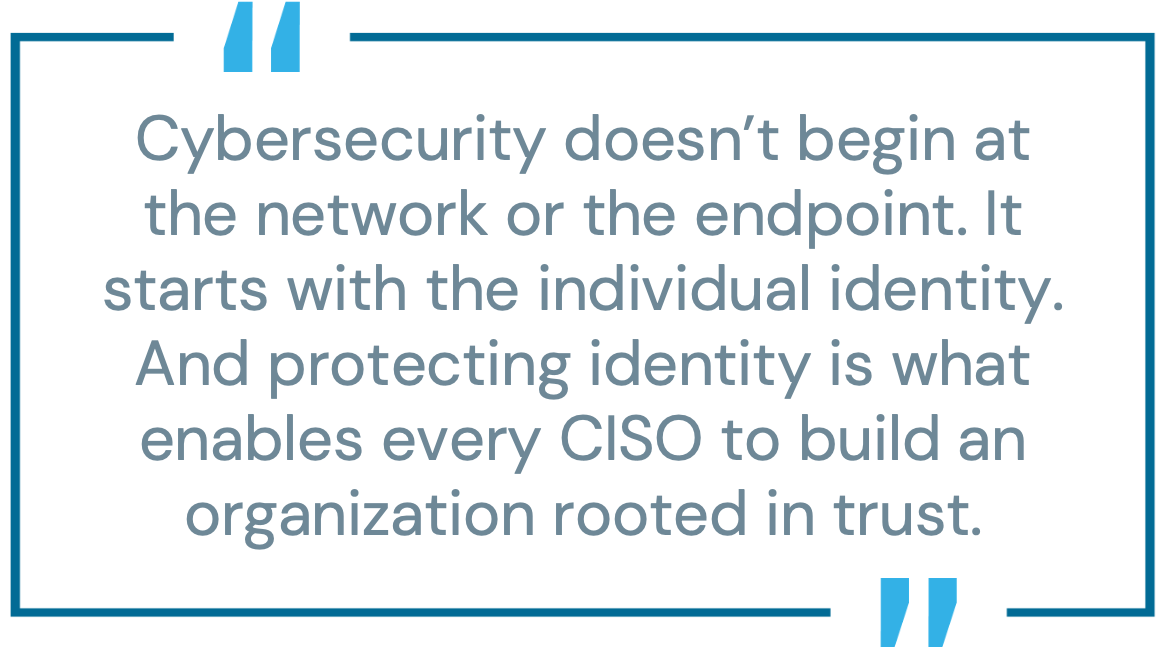
Cybersecurity doesn’t begin at the network or the endpoint. It starts with the individual identity. And protecting identity is what enables every CISO to build an organization rooted in trust.
The future of identity security in the bigger picture
As we look ahead, identity will only grow more complex, spanning not just people, but workloads, bots, and AI agents. The attack surface will evolve, but the principle remains constant: identity is everything.
For every CISO, making identity security the cornerstone of your cybersecurity strategy is essential. And it’s the difference between reacting to threats and staying one step ahead of them.
At CyberArk, that’s our mission: to help organizations secure every identity, human, AI, and machine, across every environment. Because in the end, trust is built—and defended—one identity at a time.
Omer Grossman is chief trust officer (CTrO) and head of CYBR Unit at CyberArk.
##
1 Gartner, CISOs Must Integrate IAM to Strengthen Cybersecurity Strategy, By Oscar Isaka, 17 September 2025
2 Gartner, Unlock IAM’s Strategic Value With 3 CISO Actions, By Zachary Smith, Oscar Isaka, Phillip Shattan, 9 September 2025.
Gartner is a trademark of Gartner, Inc. and/or its affiliates.

